
An early 20th-century sculptural fountain portraying the Three Graces, ancient deities of beauty, joy, and harmony.
The "Three Graces" fountain is located beside the Melik-Azaryants House, forming part of the early 20th-century architectural ensemble of Rustaveli Avenue. The composition is rooted in ancient Greek mythology: the three daughters of Zeus: Aglaea, Thalia, and Euphrosyne. In Classical antiquity, they symbolized beauty, joy, and harmony.
The fountain appeared simultaneously with the construction of the Melik-Azaryants House, intended to balance its monumental facade with a lighter and more sculpted composition. In the early 20th century, decorative fountains were seen as the hallmark of a modern urban public realm; consequently, such features were rare and regarded as emblems of civic prosperity and advancement.
The figures of the Graces form a closed circle and support the fountain basin. Thanks to flowing contours and dynamic poses, the composition conveys a sense of fluid movement. For more than a century, the fountain has remained one of the hallmark details of Rustaveli Avenue and a favored rendezvous point in central Tbilisi.
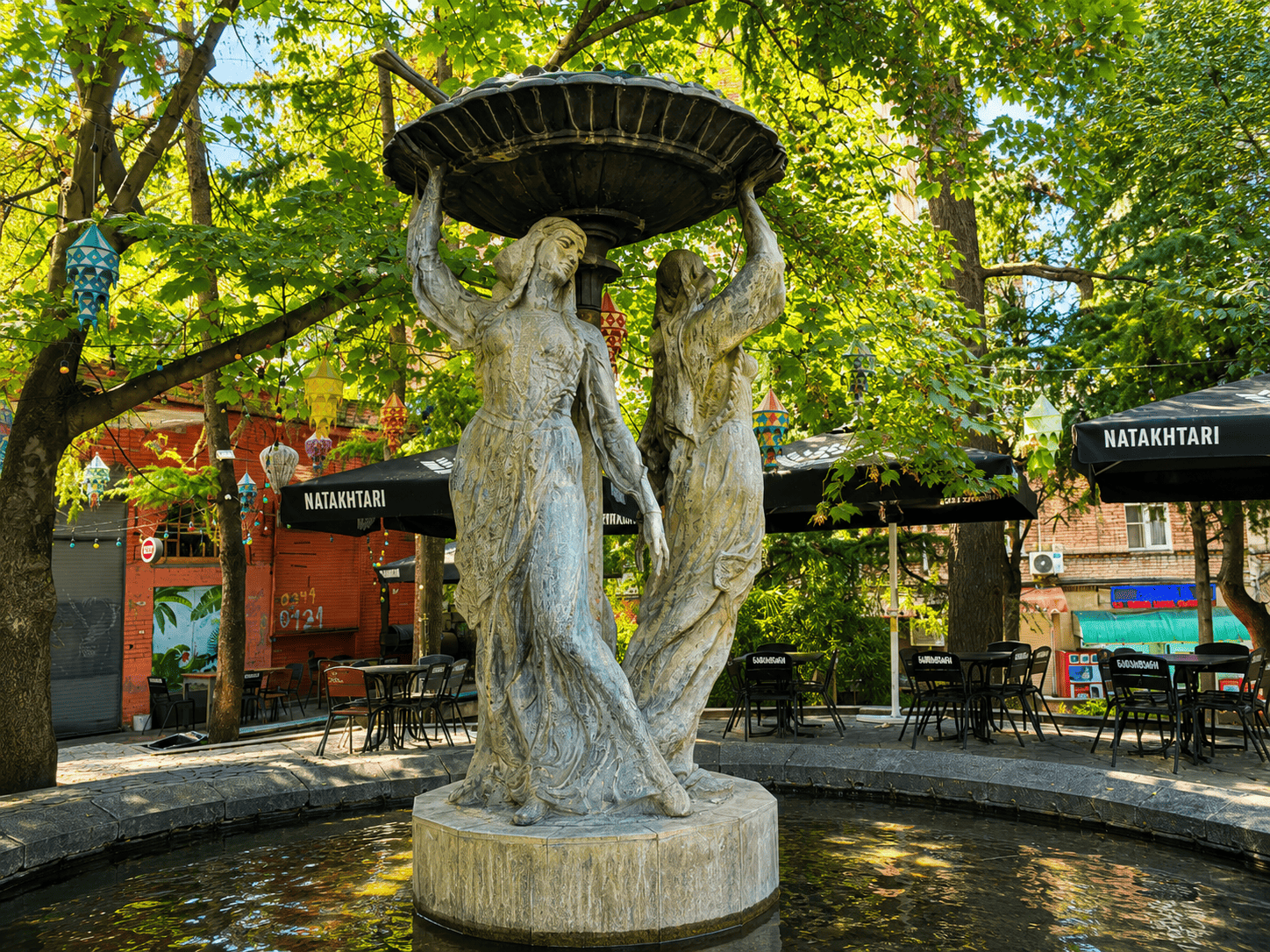
Photo: Bizzz Media


Not found
Narrated stories, archival photos, and routes you can follow on your phone.
*Instagram and Facebook are products of Meta Platforms Inc., a company recognized as an extremist organization and banned in the Russian Federation.
© 2026 Bizzz Media. Медиапортал о Грузии.
Developed in Bizzz Studio


