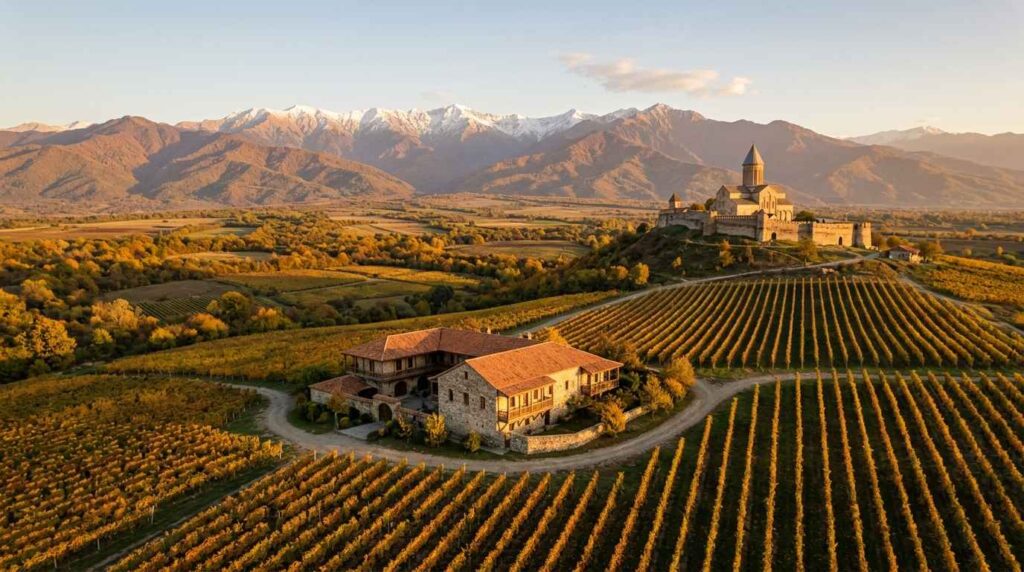
One of the oldest spiritual and scientific centers of Georgia from the 6th–12th centuries, founded by Zenon of Ikalto, the alma mater of Shota Rustaveli with ruins of the academy and an ancient marani.
Ikalto Monastery is one of the oldest spiritual, scientific, educational, and cultural centers of the Caucasus, the cradle of Georgian higher education and medieval philosophy. The complex is situated in a quiet green gorge 8 km west of Telavi. For a millennium and a half, Ikalto served as a place of prayer, scholarship, and preservation of national winemaking traditions.
The history of the monastery began in the second half of the 6th century, when Saint Venerable Zenon of Ikalto, one of the thirteen holy Syrian wonderworking fathers, founded a monastery here and engaged in preaching Christianity among the inhabitants of Kakheti. At the beginning of the 12th century, during the era of the greatest power of the Georgian state under the great King David IV the Builder, the monastery gained all-Caucasian renown: on the initiative of the king and his spiritual mentor, the outstanding theologian, poet, and philosopher Arsen of Ikalto, the famous Ikalto Higher Academy was founded at the monastery (along with the academy in Gelati becoming the "new Athens" of the Christian East).
The Ikalto Academy was built on the model of Byzantine universities and provided a fundamental education. The curriculum included the "seven liberal arts" (trivium and quadrivium): theology, philosophy, rhetoric, grammar, astronomy, geometry, and music, as well as practical applied sciences: medicine, metalworking, pottery, agronomy, and winemaking. According to historical legends, it was within the walls of Ikalto Academy that the great Georgian poet and royal treasurer Shota Rustaveli, author of the immortal poem "The Knight in the Panther's Skin," studied. In 1616, the academy building was burned and destroyed by the hordes of Persian Shah Abbas, after which the educational institution ceased to exist.
Today the architectural ensemble of Ikalto comprises three churches from different eras: the main domed Church of the Transfiguration of the Savior (Gvtaeba Church, 8th-9th centuries), erected on the site of the original church of Saint Zenon, where the relics of the holy founder lie entombed; the small hall Church of the Holy Trinity (Sameba, 6th century); and the Church of the Dormition of the Mother of God (12th century). Beside the churches, picturesque two-story stone ruins of the academy building with arched windows have been preserved. Of tremendous interest to visitors is the monastic marani (wine cellar) of the 8th-12th centuries: here in the ground dozens of giant antique qvevri and a stone wine press (satsnakheli) have survived, where academy students practiced the ancient art of Kakhetian winemaking. The monastery is nestled in the greenery of century-old plane trees and cypresses, preserving an atmosphere of serenity and profound antiquity.


Not found
Narrated stories, archival photos, and routes you can follow on your phone.
*Instagram and Facebook are products of Meta Platforms Inc., a company recognized as an extremist organization and banned in the Russian Federation.
© 2026 Bizzz Media. Медиапортал о Грузии.
Developed in Bizzz Studio