EN

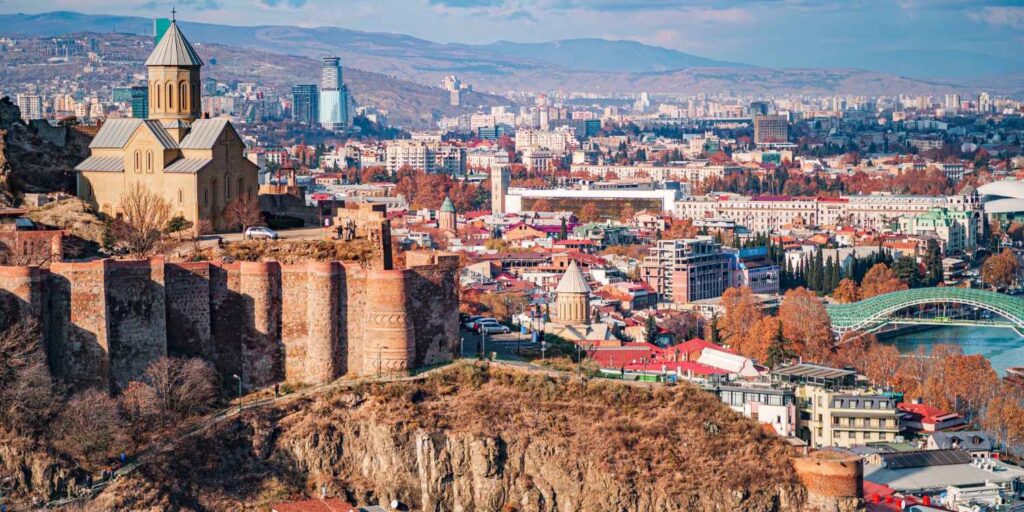
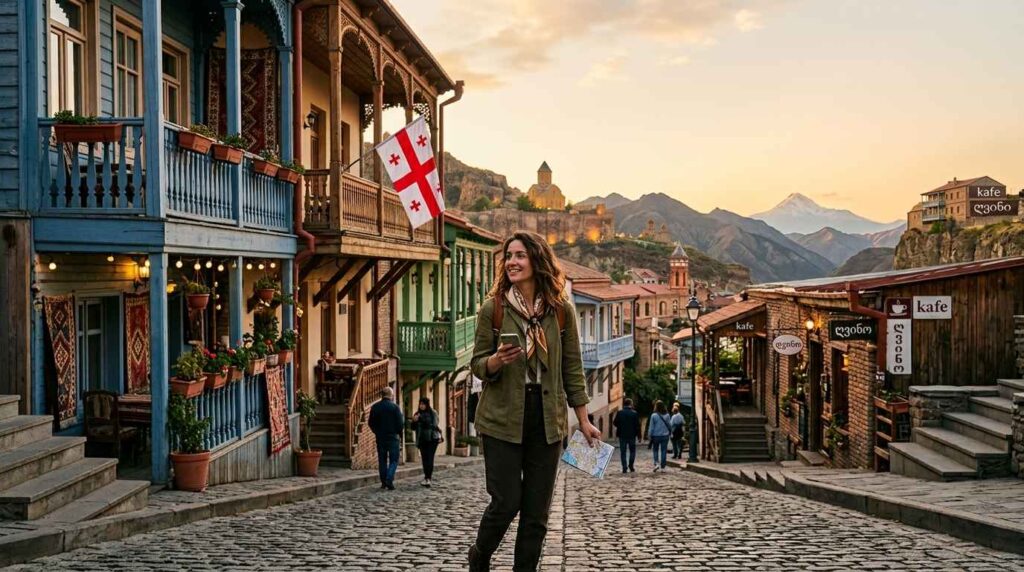
Tbilisi is usually known for postcard views: the carved wooden balconies of Sololaki, the domes of the sulfur baths, and ancient streets at the foot of Narikala Fortress. But the city has an entirely different architectural layer: bold, monumental, and cosmic.
In the 1960s–80s, Tbilisi unexpectedly became one of the main laboratories of the Soviet architectural avant-garde. Local architects were not afraid to challenge Gosstroy in Moscow and refused to build dull, cookie-cutter boxes. They boldly embedded structures into steep cliffs, suspended multi-ton concrete blocks in midair, concealed gigantic domes behind airy arcades, and built secular buildings with the fluid sculptural forms of ancient Christian cathedrals.
Today, urbanists, photographers, and seasoned travelers from all over the world seek out this Tbilisi modernism and brutalism. Below are six of the most impressive buildings of that era, along with their vivid histories, engineering secrets, and exact landmarks for a walking tour.
Table of contents:
In the early 1970s the Ministry of Highway Construction of Georgia decided to build a new headquarters for itself. The site chosen was beautiful but extremely challenging: a steep, sheer slope above the Mtkvari River with an elevation drop of more than 30 meters.
By Soviet standards, such terrain was supposed to simply be flattened with bulldozers or covered by a massive stepped foundation, clearing all the greenery. But architect Giorgi Chakhava went against the rules. He conceived the tree-building concept: envisioning the structure not as a heavy box, but as a living organism. Instead of a solid foundation, he placed three massive vertical cores on the slope and secured the office floors high above on them, like the branches of a treetop. As a result, almost the entire building hung in midair, leaving the ground beneath it untouched, and pine trees continued to grow below between the supports.
Pushing through such a bold modernist experiment during the era of standardized Soviet construction was made possible by a unique detail: architect Giorgi Chakhava himself served as Deputy Minister of Highway Construction at the time. He was effectively designing the headquarters for himself and his colleagues. Using his ministerial authority, Chakhava shielded the avant-garde project from revisions by Moscow's Gosstroy and brought it to life exactly as he envisioned.
Five horizontal two-story blocks were stacked on top of each other in a crisscross pattern. Elevator shafts and stairwells were tucked inside the vertical towers, while the floating cantilevers housed bright offices with windows overlooking the Mtkvari River and the city skyline.
In the 1990s, the ministry moved out, and the building sat abandoned for more than 10 years. The landmark was saved in 2007, when Bank of Georgia purchased the structure. The bank carefully restored the concrete structures, preserved the historic appearance, and moved its headquarters here.
You will not be able to go inside: the bank headquarters is closed to visitors, and security guards the entrance. But what matters most here is the exterior. To appreciate the scale of the suspended blocks, it is best not to stand right against the fence on Gagarina Street, but to head down to the embankment of the Mtkvari River (Right Bank) or view the complex from the Vakhushti Bagrationi Bridge. From there, you can clearly see how the concrete structure literally hovers above the wooded slope.

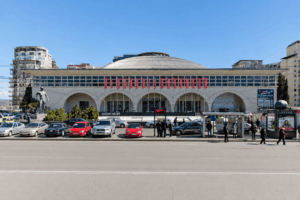
In the late 1950s, Tbilisi was crazy about basketball. The local Dinamo team was crushing opponents across the Soviet Union and was closing in on winning the European Champions Cup. The city's older venues were bursting at the seams: tens of thousands of fans tried to pack in for crucial games. The city urgently needed a giant indoor arena, and architects were handed an ambitious challenge: to build a hall for nearly 10,000 spectators where the court would be clearly visible from every single seat.
The main problem was the supports. In the vast hall, not a single intermediate column could be placed: they would obstruct the view from the stands. Then architect Vladimir Aleksi-Meskhishvili and engineer Davit Kajaia went for a bold record: they covered the arena with a monolithic reinforced concrete dome 76 meters in diameter. When Tbilisi Sports Palace opened in the spring of 1961, it was the grandest unsupported dome in the entire Soviet Union and one of the largest in Europe.
The exterior architecture of this building is intriguing. If you stand in bustling May 26 Square right in front of the entrance, it is impossible to feel the scale of the structure. The building greets you with a disciplined row of tall arches and a glazed lobby, appearing almost flat: the gigantic dome is concealed behind the facade's parapet and is barely visible from the sidewalk. The architects deliberately created this optical effect so that the massive engineered structure would not overwhelm the public square.
To truly appreciate the scale of this "flying saucer," it is best to view the building from a distance: for instance, from the upper floors of the hotel across the street or from the hills of the neighboring Saburtalo district.
Inside, the arena still leads a vibrant life: the Georgian national basketball team plays here, tennis tournaments take place, and stadium concerts are held for 11,000 spectators.
You can only get inside with a ticket during scheduled events. If you want to see the historic dome from the interior, check the city event listings before your trip: sports matches and concerts take place here year-round. Just do not confuse the Sports Palace with the New Olympic Palace on University Street; that is a completely different modern arena.

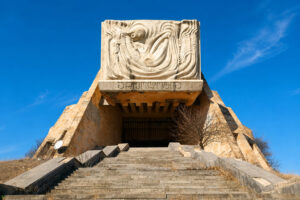
In the 1970s–80s, large-scale excavations were underway on the Digomi Plateau: archaeologists discovered exceptionally rich ancient settlements and kurgans from the Bronze and Early Iron Ages here. There were so many finds that the chief architect of Tbilisi, Shota Kavlashvili, and his colleague Shota Gvantseladze decided to build Archaeological Museum right at the excavation site: on a high point of the hill above the Georgian Military Road.
To emphasize the essence of the site, the architects abandoned conventional windowed exhibition halls and disguised the building itself as an ancient burial mound. The massive cylindrical structure was literally cut into the hillside. A wide grand stone staircase leads up from below, and directly above the entrance portal hangs a cyclopean slab resembling the slightly open lid of a sarcophagus. It bears a bas-relief crafted by sculptor Tengiz Kikalishvili. It portrays a person lying in a ritual burial in the fetal position, which is exactly how people were buried on this land about three thousand years ago.
The building met a dramatic fate. Construction was finished in 1988, at the very twilight of the Soviet era, and the complex functioned as a full-scale museum for only a couple of years. During the turbulent 1990s, for safety reasons, the unique gold collections and excavated artifacts were hastily evacuated to the storage vaults of the National Museum on Rustaveli Avenue. The halls stood empty, the doors were boarded up, and the futuristic "ziggurat" was left towering alone above Tbilisi.
You cannot go inside today: the building is mothballed. Even so, it is worth heading up here for the lost-temple atmosphere and the cinematic view of the city. You cannot walk all the way around the complex: right behind it begins a strategic zone of the city reservoir marked with warning signs. However, you can freely climb the monumental staircase, study the bas-relief details up close, and take fantastic, textured photos.

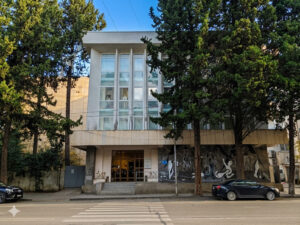
On quiet Merab Aleksidze Street, deep in the student area of Saburtalo, stands a building that resembles an impregnable fortress. It has almost no windows: a heavy monolithic cube of concrete and light-colored tuff with blank stone walls looms over the transparent glass ground floor.
This closed facade was not an architectural whim, but a matter of strict scientific calculation. Architects Givi Lezhava and Iosif Liberman, who designed the building in 1970 for the Georgian Academy of Sciences, built it as a giant safe. Direct sunlight is destructive to rare paper, so the multi-tiered book repositories were hidden inside the solid stone core of the structure, where constant temperature and humidity are maintained. By contrast, the reading rooms were moved downstairs toward ribbon glazing and internal courtyards filled with soft, diffused light.
The National Science Library itself grew out of a closed departmental collection founded back in 1941. Only academicians and professors were permitted to use it. Today, it is Georgia's main scientific book repository: more than 3.5 million volumes are stored on the shelves: from medieval treatises to rare periodicals from around the world.
Unlike the boarded-up museum in Digomi, the library is thoroughly active. Inside, a stunning 1970s modernist interior has been preserved: wide marble staircases, wood paneling, rows of wooden index card drawers, and the meditative quiet of the reading rooms.
You can easily walk in off the street: at the entrance, just show your passport and get a one-time guest pass. Inside, there is a quiet cafe where you can have coffee with your laptop among Tbilisi students and feel the atmosphere of last century's academic Tbilisi. Before visiting, visit the official website sciencelib.ge, where you can confirm opening hours on holidays.

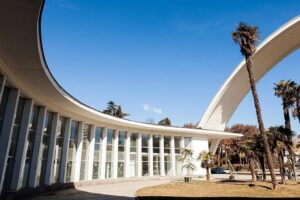
If you turn off the noisy and dusty Tsereteli Avenue behind the wrought-iron gates of "Expo Georgia", you instantly step into another world of silence, pine-scented air, and shady alleys, leaving the roar of cars behind. The complex was built at the turn of the 1950s–60s as a republican VDNKh: a showcase of the achievements of Soviet Georgia. On the park's 15 hectares, the architects built not just an exhibition, but a miniature architectural town.
Eleven authentic modernist pavilions have survived here, each with its own character. The main masterpiece of the complex is Pavilion No. 3 with a bold wave-shaped roof that hovers above a continuous glass wall. Nearby hides a futuristic greenhouse under a Buckminster Fuller-style geodesic dome: an openwork frame sphere of hundreds of metal triangles, through which palm trees reach toward the sky.
As you walk along the alleys, be sure to look closely at the facades: the pavilion walls preserve expressive bas-reliefs and Thaw-era mosaic panels featuring figures of winemakers, metallurgists, and symbolic motifs.
Today, this is the city's main exhibition venue: it hosts major international book fairs, wine salons, and the contemporary art event Tbilisi Art Fair. But the charm of Expo Georgia is that even when there are no exhibitions, the grounds are open to everyone as a public park.
Admission to the park area is open and free every day. It is a great place to come for 1.5–2 hours: sit by the pond with water lilies, admire the architectural details of the pavilions, and drink coffee in the quiet among centuries-old pines. You can only get inside the buildings themselves during official events: the schedule of upcoming exhibitions is published on the website expogeorgia.ge.

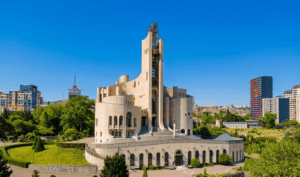
In the late 1970s, rebel architect Viktor Djorbenadze received a rather mundane task from the party leadership: to build a main Wedding Palace for Tbilisi. But instead of a boring Soviet registry office, the architect created something unheard of for an atheistic state: he built a real Christian church.
Djorbenadze masterfully blended medieval Georgian architecture with expressionism. The snow-white volumes of the building spiral upward, soaring as a bell tower, while inside lie high vaulted halls with stained glass and an organ. Officials did not dare ban the masterpiece: the structure turned out so monumental and distinctive that they immediately began showing it to high-ranking foreign guests. Margaret Thatcher personally admired the palace during her visit to Tbilisi, and in 1990, the great ballerina Maya Plisetskaya and composer Rodion Shchedrin celebrated their golden wedding anniversary right here.
After the collapse of the Soviet Union, the building fell into disrepair and was nearly demolished, until businessman Badri Patarkatsishvili bought it in 2002. He invested millions of dollars in its restoration, restored the building to its former grandeur, and turned it into his private residence, Arcadia. In 2008, following Patarkatsishvili's sudden death in London, his body was brought to Tbilisi and laid to rest right here, in the garden beside the palace walls.
Today Palace of Rituals remains privately owned and operates as a private venue for premium weddings and celebrations. From Bochorma Street, you cannot go inside past the tall, solid gates. But to appreciate the scale of this "white ship", you do not even need to go inside: the most breathtaking view opens from the opposite left bank of the Mtkvari (from the embankment or the 300 Aragveli Bridge) or from the cable car to Narikala Fortress. From there, the palace appears in all its grandeur, like an ancient monastery soaring above the Tbilisi river.
Six buildings from our selection are scattered across different corners of Tbilisi: from the northern hills of Dighomi to the embankment near Ortachala. The distance between the outermost points exceeds ten kilometers, so trying to cover all the locations on foot in a single day is a bad idea: you will spend half a day navigating noisy interchanges and bridges.
It is much more convenient to divide the architectural route into two logical itineraries:
Four of the six buildings are located relatively close to each other along both banks of the Mtkvari:
The remaining 2 sites stand apart, and it is best to combine them with the first walk by car:
💡 Transit tip: The Tbilisi metro easily connects Saburtalo and Didube (a ride costs just 1 GEL with a transit card), and for farther spots, feel free to use city taxis (Bolt or Yandex); rides around town are inexpensive and save a lot of energy.

If you want to listen about these buildings on site, BeeTravel has the audio guide "Soviet Tbilisi: Brutalism". Of the six sites in this article, four are included in it: the Ministry of Highway Construction, the Archaeological Museum, the Sports Palace, and the National Science Library. "ExpoGeorgia" and the Palace of Rituals are part of another route, "Soviet Tbilisi: Modernism".
The audio guide opens in your smartphone browser via your account, without needing to install an app. The first stops on the route are available for free in the demo version.
Tbilisi's Soviet architecture is unique because it is almost entirely free of the usual dreary prefabricated panels. Georgian architects managed to turn rough gray concrete into a national manifesto: they masterfully combined bold global expressionism with the steep Caucasian terrain and traditions of medieval church architecture.
The fate of these buildings turned out differently. Some are enjoying a second youth as ultra-modern offices and exhibition parks, while others are mothballed or hidden behind closed gates. But each of them is a monument to a daring era when architects were not afraid to dream big and defy the laws of gravity.
If you want to see Tbilisi beyond its postcard tourist facade, set aside half a day for these concrete masterpieces. The city is guaranteed to reveal a completely unexpected, powerful side to you.