EN
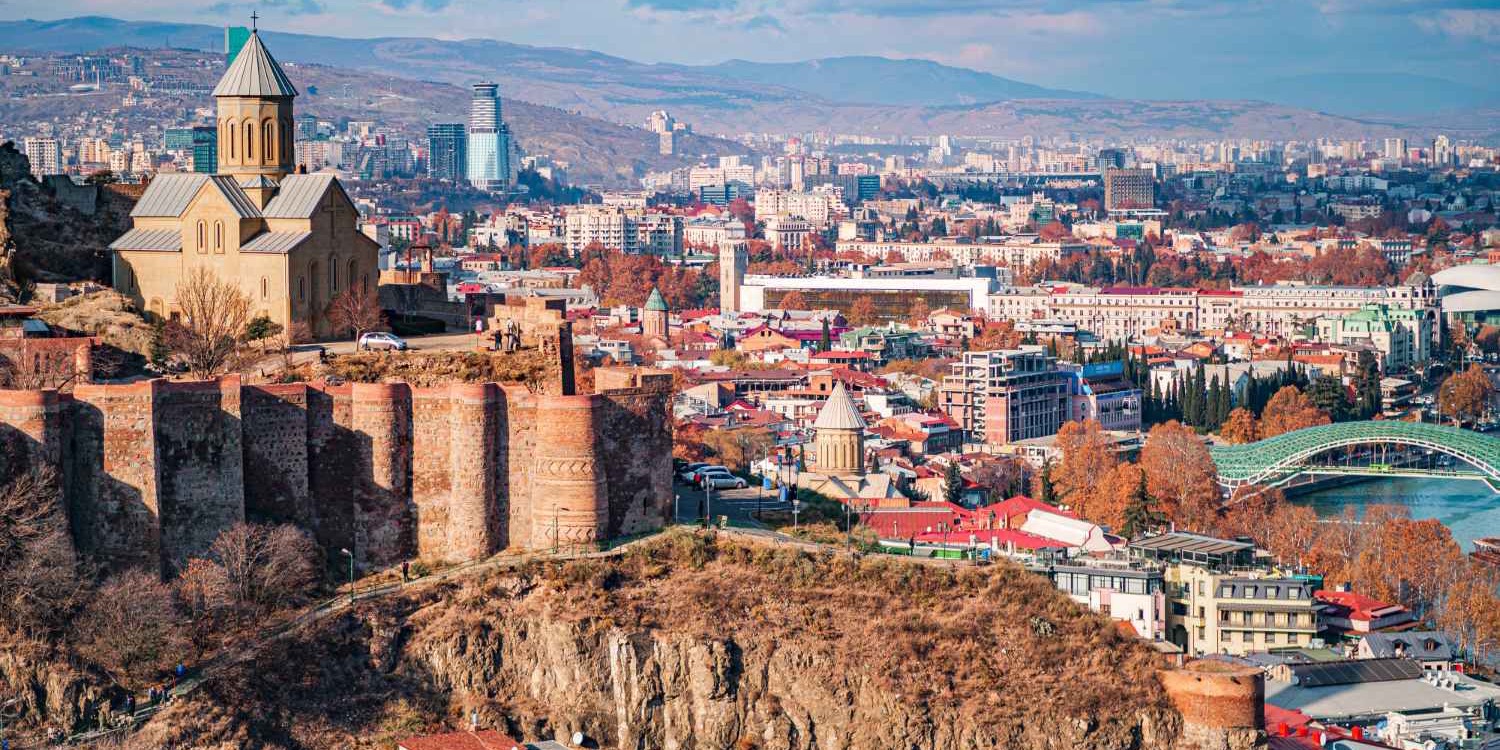
Tbilisi is an amazing city that makes you fall in love from the very first walk. If you only have one day, you do not need to try to do everything all at once. We have put together a convenient and relaxed walking route through the most atmospheric places: from ancient streets with carved balconies and a waterfall in a rocky gorge to sulfur baths, panoramic views from the cable car, and sunset atop Mount Mtatsminda. The walk is structured sequentially and logically so that you enjoy this day with pleasure and feel the true character of the city.
Table of contents:
When planning a trip to Tbilisi, it is important to think through in advance how you will reach the city. We will examine the most convenient and proven options: by plane, as well as by train, car, or transfer if you are already in Georgia.
Airplane: the fastest and most comfortable way to get to Tbilisi is to arrive by plane. The city is served by Shota Rustaveli International Airport (TBS), located just 15–20 minutes by car from the center. At present, regular direct flights operate from Moscow, St. Petersburg, Sochi, Mineralnye Vody, and other major cities, as well as convenient connecting flights via Yerevan, Baku, or Istanbul. Ticket prices depend on the season and time of purchase, but on average you can count on 8,000–22,000 rubles for a one-way ticket per person.
Upon arrival at Tbilisi airport, getting to the city center is very simple. The most convenient option is to take a taxi via the Bolt or Yandex Go mobile apps: the ride takes about 25–30 minutes and costs approximately 25–35 GEL. Another excellent and budget-friendly method is to use city bus No. 337: it runs around the clock every 15–20 minutes and for just 1 GEL will take you straight to the Avlabari and Freedom Square metro stations.
Train: if you are already traveling in Georgia (for example, vacationing on the Black Sea coast in Batumi), the train is a maximally comfortable, safe, and pleasant way to reach the capital. Modern double-decker Stadler trains with panoramic windows, power outlets, and air conditioning run daily between Batumi and Tbilisi. The journey takes about 5 hours. A second-class ticket costs around 35 GEL, and we recommend purchasing it in advance online on the official Georgian Railway website tre.ge or via the TKT.ge service, as tickets sell out quickly during the high season.

Car with a driver within the country: a very popular and convenient option among travelers is the gotrip.ge service. This is car rental with a local driver. The main advantage of the service is that the trip price is fixed on the website in advance, and along the way you can make as many stops as you like for beautiful photos near mountain passes, buying fruit, or coffee without extra charges. It is also easy to choose a Russian-speaking driver with good reviews there.
In your own car from Russia: if you are driving to Tbilisi in your own car, the journey follows the legendary Georgian Military Highway through the only land border checkpoint, the Upper Lars checkpoint. The road across the Cross Pass and Gudauri is extraordinarily scenic, but it is important to remember that the exact border crossing time cannot be predicted: everything depends on queues and weather in the mountains. In winter and the off-season, traffic across the pass may be temporarily suspended for snow clearing due to snowfall or black ice, so a car trip should always be planned with plenty of buffer time.
Tbilisi is a hilly city, but a large part of its historical center is very compact. Practically our entire route can be walked on foot while examining the carved details of antique houses. If you need to travel to distant points or climb a mountain, public transport and taxis are excellently developed in the city.
Metro and city buses: this is a modern and very economical way of getting around. The Tbilisi metro consists of two lines, and the central stations are Freedom Square and Rustaveli. Fares on the metro and comfortable blue buses cost just 1 GEL. Furthermore, within 90 minutes of the first payment, free transfers to other municipal transport apply. It is most convenient to pay fares with the unified MetroMoney card (available for 2 GEL at any metro ticket counter) or with contactless bank cards from foreign banks.

Taxis: in Tbilisi this is a very affordable and comfortable mode of transport. We recommend ordering cars via the Bolt or Yandex Go apps: this saves you from haggling with street drivers, and a ride across the center will cost just 4–8 GEL.
Car trips: with a driver or independent rental. For getting around the historical center of Tbilisi itself, a car is objectively not needed: traffic is dense, streets are narrow and steep, and parking spaces are in severe shortage, so traveling on foot and by taxi is much faster and more convenient. However, if you plan to travel outside the city (for example, to ancient Mtskheta, the cave town of Uplistsikhe, or the wine region of Kakheti), a car becomes the primary choice.
Tbilisi Funicular: this legendary transit link has been carrying guests up Mount Mtatsminda since 1905. The cars conquer a steep ascent over 500 meters long, making an intermediate stop at the Pantheon of Writers and Public Figures. At the upper station, an expansive panorama of all Tbilisi opens up, with an amusement park and the famous restaurant complex in operation. A separate Mtatsminda Park card is required for fare payment (costs 2 GEL, the ride itself is 10 GEL). In our walking route, the funicular serves as a vivid evening finale for greeting the sunset over the capital.
Cable car: connects Rike Park and the ancient Narikala Fortress on the hilltop. This is not merely transit, but one of the best panoramic attractions in the city. The cost of a ride is 3.5 GEL with a MetroMoney card, and the view from the transparent cabin over the old quarters and the Mtkvari River impresses even seasoned travelers. The cable car ride is organically included in our one-day route between Rike Park and Narikala Fortress.

Before starting the walk, it is worth sorting out a couple of basic organizational matters, regarding connectivity and money, so as not to be distracted by routine trifles during the day.
Connectivity and internet: physical SIM card or eSIM. Stable mobile internet is essential for navigating narrow lanes, hailing taxis, and looking up locations. There are two primary options:
Physical local SIM card: can be purchased upon arrival at the airport or at official operator offices in the city center (on Freedom Square and Rustaveli Avenue). Leading operators are Magti, Silknet and the Cellfie. For travels around Georgia, Magti is renowned for the best and most stable coverage (confidently receiving signals even on mountain passes). An international passport is mandatory to register a physical card.
eSIM (digital SIM): the most convenient and fastest format if your smartphone supports virtual SIM cards. An internet package can be arranged and activated online in advance even before departure (via international services like Yesim, Airalo, or inside operator apps): internet connectivity will appear immediately upon touchdown without having to stand in lines at the airport.
Currency: what to bring and where to exchange. The official currency of the country is the Georgian lari (GEL). The question of what to bring along, dollars, euros, or rubles, is resolved simply: you can travel to Tbilisi with any of these currencies without worry.
Dollars (USD) and euros (EUR) are accepted absolutely everywhere at favorable exchange rates. Rubles (RUB) are also freely and without restrictions exchanged for lari in most exchange booths in Tbilisi, but we advise exchanging them before departure for dollars or euros: that way the exchange rate is more advantageous.
Where to exchange: do not exchange large sums at airport exchange counters, because the rate there is much lower. Exchange 20–30 GEL for the trip to the city, and exchange the main sum in the center: the largest number of reliable exchangers with favorable rates is concentrated on Freedom Square, Kote Abkhazi Street, and Rustaveli Avenue. Choose booths with large digital boards and a "0% commission" notice.
Bank cards: Russian bank cards (including the Mir system) do not work in Georgia due to sanctions. Foreign bank cards (Kazakhstan, Belarus, Armenia, EU countries) are accepted practically everywhere: in hotels, restaurants, and supermarkets. Nevertheless, always keep a supply of cash lari on you (at least 40–50 GEL): you will need them at markets, in souvenir shops, for buying church candles, and for paying for the cable car or funicular.
Medical insurance: starting in 2026, medical insurance became a mandatory requirement for entering Georgia for all tourists. The policy must be valid for the entire period of stay in the country and cover basic medical expenses (emergency care and hospitalization, with coverage from $30,000). Without it, not only is there a risk of entry denial or a fine, but any medical assistance for foreign citizens will incur charges. Read more about the nuances and getting a policy in our article:
One day in Tbilisi is an exciting route where over twelve hours you can touch fifteen hundred years of history, hear the roar of a real mountain waterfall right in the center of the capital, soar above the river in a panoramic cable car cabin, and spend sunset atop Mount Mtatsminda. We have designed a thoughtful circular walking route combining the city's key signature sights and colorful secrets.
In this route, we have combined the capital's main attractions: ceremonial Freedom Square, carved historic mansions of Sololaki, the fairytale tower of the Rezo Gabriadze Theater and neighboring Gabriadze Cafe, the futuristic Bridge of Peace and the cable car to the ancient Narikala Fortress. You will stroll to a genuine waterfall in a rocky gorge, see the domes of the sulfur baths, and in the evening welcome sunset on the summit of Mount Mtatsminda with a view of the glowing city.
Getting to know Tbilisi is best started from Freedom Square: this is the central transit hub, easiest to reach by metro or taxi, and the most convenient place to begin a walking tour through historical quarters.

For those who want to immerse themselves as deeply as possible in the city's atmosphere without being distracted by reading from a screen on the go, we created the original "Soul of Old Tbilisi" audio guide from BeeTravel. It is accessible right in the browser of any smartphone via a convenient personal account (without installing apps or bots).
The route includes more than 20 atmospheric locations in the historical center: from ceremonial historic mansions and squares to secret courtyards preserving the spirit of the early 20th century. For each location, lively audio stories, archival photographs, and links to Google Maps and Yandex Maps for easy navigation have been prepared.
🎧 The first 5 stops of any route can be listened to for free in demo mode without registration.
Below is a detailed step-by-step route for an independent walk with exact descriptions of each location, approximate timing, and an interactive map.
An approximate daily schedule will allow you to distribute your energy wisely, avoid the midday heat on steep climbs, and greet the evening at the capital's best viewpoint:
09:30 – 12:30 | Morning: Old Town and the origins of Tbilisi. Starting at Freedom Square, morning quiet in the ancient Anchiskhati Basilica, the fairytale clock of the Gabriadze Theater, and a walk through the cool canyon to the Leghvtakhevi Waterfall.
12:30 – 14:30 | Afternoon: Sulfur baths and a traditional Georgian lunch. The historic domes of Abanotubani, oriental mosaics of the Orbeliani Bathhouse, and a well-deserved leisurely lunch with juicy khinkali, hot khachapuri, and a glass of Saperavi.
14:30 – 16:30 | Afternoon: Bridge of Peace, cable car, and Narikala Citadel. Crossing the soaring glass Bridge of Peace into Rike Park, an exciting ride on the cable car above the Mtkvari, the ancient towers of Narikala Fortress, and the panorama from the viewpoint by the Mother of Georgia monument.
16:30 – 18:30 | Late afternoon: Mansions and entryways of bohemian Sololaki. A scenic descent from the Sololaki Ridge into a quiet district of 19th-century mansions: Moorish halls of the Kalantarov House, the cozy courtyard of the Writers' House of Georgia, and magical stained glass of the Kaleidoscope hallway.
18:30 – 21:00 | Evening: Tbilisi Funicular, sunset on Mtatsminda, and dessert. A ride on the legendary funicular to the summit of the Holy Mountain, golden sunset over the city, famous Tbilisi donuts in the restaurant complex, and nighttime Tbilisi in a sea of lights.

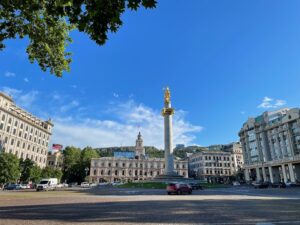
Getting to know Tbilisi begins at Freedom Square, the historical heart of the capital, where the country's destiny was decided and turbulent political life unfolded for two centuries. In the very center of the square, a 35-meter granite column rises high, crowned by the radiant Freedom Monument by Zurab Tsereteli. The five-meter figure of Georgia's main patron saint, Saint George slaying the dragon, is cast in bronze and covered with pure gold leaf. Against the sky, the multi-ton sculpture seems to float in the air, symbolizing the radiant victory of good over evil, while majestic 19th-century neoclassical facades and the former City Duma building line the perimeter of the square.
A gripping detective story worthy of a movie is tied to this place. On the hot morning of June 26, 1907, right across the cobblestones of the square, then called Erivansky Square, two phaetons carrying a huge sum of money for the State Bank were moving under Cossack escort. Suddenly, bombs were thrown under the horses' hooves: explosions shattered windows in all surrounding mansions, panic and a fierce shootout erupted, and the raiders made off with a fabulous sum of about 340,000 rubles. Historians agree that the secret mastermind behind this daring heist was young Joseph Jughashvili (the future Stalin), and the seized funds went to finance Vladimir Lenin's party. Ironically, in 1956 on this very square, Soviet authorities erected a gigantic monument to Lenin, which stood until August 1990, when a jubilant crowd of city residents sent it into history.
🕐 Approximate visiting time: 15–20 minutes.


Down Baratashvili Street, on the quiet pedestrian Shavteli Street, stands a modest building of ochre-yellow tuff that seems to have grown into the ground over long centuries: this is Anchiskhati Basilica (Church of the Nativity of the Mother of God), the oldest surviving church in Tbilisi. It was built in the early 6th century under King Dachi of Ujarma, son of the city's founder Vakhtang Gorgasali, during the relocation of the capital from Mtskheta to Tbilisi. Unlike traditional Georgian cathedrals, Anchiskhati is an austere three-nave basilica without a high dome. If you look closely at the lower courses of masonry, you can see authentic smoothly hewn tuff blocks from the 6th century that witnessed the first kings of a united Kartli.
The church received its popular name in the 17th century thanks to the greatest national relic: the not-made-by-hands encaustic icon of the Savior, painted with hot wax. Rescued from Ottoman raids, the icon was brought from Anchi Monastery and delivered to Tbilisi in 1664, giving the sanctuary the name "Anchis-khati" ("Icon of Anchi"). Specially for it, the outstanding 12th-century goldsmith Beka Opizari created a masterpiece of medieval repousse work: a silver revetment with gold inserts. The basilica miraculously survived centuries of destruction, and in Soviet years was preserved because artists' studios were arranged inside. Today the original holy icon is kept in the Art Museum of Georgia, but in the silence and solemn dimness of Anchiskhati, the sensation of touching the origins of faith still lives on.
🕐 Approximate visiting time: 15–20 minutes.


On pedestrian Shavteli Street, attention is drawn to an unusual leaning clock tower: the Rezo Gabriadze Puppet Theater. The outstanding screenwriter of cult films Mimino and Kin-dza-dza!, sculptor, and playwright erected this tower in 2010 not merely as an urban ornament, but as a tribute to disappearing old Tiflis. For years, Rezo personally gathered authentic antique bricks, tiles, and fragments of 19th-century cast-iron railings from the ruins of dismantled Tiflis buildings, integrating them into the masonry. Supporting the leaning silhouette of the tower from below is an authentic massive beam from the dismantled Mukhrani Bridge over the Mtkvari.
The tower facade is decorated with hundreds of miniature tiles painted by hand by Gabriadze himself. Pay attention to the golden Latin inscription right beneath the clock: "Extra Cepam Nihil Amplius Requiratur" ("May tears only flow from cutting onions"), which is the theater's artistic motto devised by the master. Every hour, a golden-winged angel emerges from a gilded upper-tier window, rhythmically striking the bell with a hammer to mark the time. At exactly 12:00 and 19:00, a painted curtain opens on the middle balcony, and to a lyrical melody, the puppet performance "Circle of Life" begins, showing the human journey from cradle to eternity without a single word. The theater itself inside is very intimate, seating just 80 spectators, and tickets here sell out months in advance.
Right at the foot of the tower operates the famous and remarkably atmospheric Gabriadze Cafe with an original artistic interior, painted tables, and a cozy terrace. Here it is delightful to pause, sip coffee brewed on sand, and sample signature desserts.
🕐 Approximate visiting time: 15–20 minutes (or slightly longer to wait for the clock chime).
Leaving the puppet tower behind, we head south through the ancient Kala quarter. We pass wine cellars, shops with minankari cloisonne enamel, and street artists, cross Leselidze Street, and delve into a picturesque rocky canyon unexpectedly tucked away right amidst dense urban development.


Walking through the colorful quarters of the Old Town to the foot of the cliffs, you will find yourself in a genuine natural wonder: the deep Fig Canyon (Leghvtakhevi), cutting through the city center. It is difficult to imagine that under residential houses lies a gorge 250 meters long with sheer 50-meter cliffs of dark layered sandstone. The first chronicle mentions of the canyon date back to the 15th century: the Tsavkisistskali River served as a natural defensive boundary for old Tiflis, while wild fig trees grew in abundance on the slopes, giving the gorge its historical name.
Along the riverbed run wooden footbridges hung with lovers' padlocks, while overhead the old residential balconies hovering directly above the chasm take your breath away. Deep in the gorge roars the 22-meter Leghvtakhevi Waterfall, cascading in a turbulent stream into a stone basin. Until 2012, the canyon was concealed by sewer collectors and filled with earth, but after extensive clearing, life returned here: in summer a welcome humid coolness reigns, and in rare frosty winters the waterfall streams freeze, turning into a gigantic ice icicle.
🕐 Approximate visiting time: 20–30 minutes.
Having enjoyed the cool air and water spray of the waterfall, we return across the wooden footbridges along the bed of the Tsavkisistskali stream back to the entrance of the gorge. The canyon walls part, a characteristic warm sulfur aroma appears in the air, and right in front of us rise round brick domes resembling the shells of giant tortoises.


At the exit of Fig Gorge, the air fills with warm mineral steam: before you is the Abanotubani quarter, from which Tbilisi began. It was right here that King Vakhtang Gorgasali discovered warm sulfur springs gushing from the ground (+37...+40 °C) and ordered the founding of a city named "Tbilisi" from the word "tbili" ("warm"). The baths themselves are built directly above the thermal springs below ground level, while on the street only neat brick domes with glass ventilation windows are visible, across which you can easily walk during your stroll.
In the 18th–19th centuries, the sulfur baths were not just a place for hygiene, but the main social club of Tiflis: people debated politics, signed trade contracts, matched brides, and held banquets here. The architectural highlight of the district is the famous Orbeliani Bathhouse (Chreli Abano) with its azure oriental mosaic facade and minarets. On its wall gleams an enthusiastic quote from Alexander Pushkin: 'Never in my life have I encountered anything more luxurious than the Tiflis baths.' Today, a hot mineral bath and a traditional soapy massage with a kese glove remain the best way to relieve fatigue after a long walking day.
🕐 Approximate visiting time: 20–30 minutes (for a walk across the domes and photos).
By the time you walk through Abanotubani, you will have completed a good half of your morning route: the ideal time to take a break for a hearty and unhurried Georgian lunch. The sulfur baths district and neighboring Meidan Square are literally dotted with dukhan taverns, family restaurants, and cozy terraces.
For lunch, we recommend ordering classics of the local cuisine:
Khinkali: traditional "kalakuri" (with a filling of beef and pork spiced with cilantro) or "mtiuluri" (mountain style, without greens). They are eaten exclusively by hand, carefully nibbling a small bite on the side and drinking the hot, rich broth.
Khachapuri: fluffy Imeretian with young cheese inside, or "megruli" (Megrelian style) with a double serving of melted cheese on top.
Badrijani: tender rolls of fried eggplant with walnut paste, garlic, and pomegranate seeds, an ideal appetizer for an easy start.
Ojakhuri or shkmeruli: if you crave something truly hearty, roasted meat with potatoes on a clay ketsi pan, or juicy chicken in a garlic-cream sauce.
You can choose a suitable establishment by reviews, interior, and average bill in our catalog of Tbilisi restaurants: vetted spots from authentic old taverns to modern panoramic terraces are gathered here.
Having gathered strength and enjoyed Georgian hospitality, we head out to the embankment of the Mtkvari River. The ancient stone masonry of the medieval city gives way abruptly to bold contemporary architecture: an airy wave of glass and steel hovers right above the water.


Above the water surface of the Mtkvari hovers the undulating pedestrian Bridge of Peace, thrown across the river to a design by world-renowned Italian architect Michele De Lucchi. The 156-meter structure of glass and steel has become a bold symbol of modern Tbilisi, creating a captivating visual contrast with antique tiled roofs and medieval rocky crags. The bridge opens up a magnificent panoramic view of both riverbanks, Narikala Fortress, and the presidential palace.
The bridge's main magic unfolds at dusk, when the unique illumination created by French designer Philippe Martinaud switches on. Thousands of built-in LEDs broadcast Morse code in running lights every hour: encrypted light pulses transmit the names of elements from Mendeleev's periodic table that make up the human body. This deep philosophical message of the architect reminds all visitors and residents of the city that people across the entire planet are woven from the same matter, regardless of nationality, religion, or borders.
🕐 Approximate visiting time: 15–20 minutes.
Having crossed the bridge to the left bank, we turn right and look up at the grand rocky bluff towering over the river. Right above the dizzying precipice proudly rises the austere silhouette of Metekhi Church and an equestrian statue of the founding king, as if guarding the tranquility of the ancient capital.

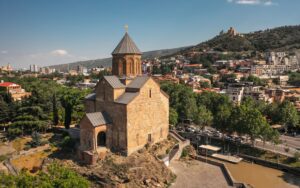
Crossing to the left bank toward the foot of Metekhi Cliff, you will climb to the top of the impregnable crag to Metekhi Church (Church of the Nativity of the Blessed Virgin Mary). Its austere greenish-tuff walls, 1.5 meters thick, crowned by a brick dome, look like a natural continuation of the cliff. The church was erected in the 13th century by King Demetre II the Self-Sacrificer on the site of an ancient 5th-century royal palace. Inside the church, strict silence reigns, and near the altar rests a great relic of Georgia: the tomb of the holy martyr Shushanik, a 5th-century princess who endured years of imprisonment for fidelity to her beliefs.
The history of Metekhi is full of drama: Mongols burned the church, in the 17th century it was converted into a gunpowder magazine, and in the 19th century Tsarist authorities turned it into a prison where Maxim Gorky and revolutionaries were held. In 1937, Lavrentiy Beria ordered the church demolished, yet Georgian cultural figures, artist Dimitri Shevardnadze and writer Mikheil Javakhishvili, defended the sanctuary at the cost of their own lives. Today, an equestrian monument to the city founder Vakhtang Gorgasali by Elguja Amashukeli rises on the cliff edge: the mighty warrior-king in a battle helmet with a wolf's head holds his horse's reins, eternally blessing the city he founded.
🕐 Approximate visiting time: 20–25 minutes.
We descend from the Metekhi viewing terrace along gentle cobblestones back to the embankment and enter expansive Rike Park. After the narrow streets of the Old Town, a remarkable spaciousness opens up here: fountains splash, green lawns invite relaxation, and right in front of us rises the lower station of the cable car.

From Metekhi Cliff, a pathway leads into the spacious green Rike Park, spread across the left bank of the Mtkvari. Until the 1970s, the famous Peski trading quarter bustled here with oriental caravanserais and artisan shops, until the area was cleared due to frequent seasonal floods. In the early 21st century, an ultra-modern landscape park was laid out here, whose bird's-eye contours resemble the map of Georgia. The park has become a favorite recreation spot for citizens: plane trees and decorative shrubs are planted here, shady avenues are laid out, and playful art objects are installed, such as a giant white grand piano in the middle of a lawn.
Special attention is drawn to the nine-meter wrought-iron "Tree of Life" by sculptor Davit Monavarlisashvili: antique cast-iron stove dampers are built into its metal trunk and branches, where tourists drop notes with their most secret wishes. In the evenings in the center of the park, singing fountains come alive with laser lighting and dancing water jets. But the main asset of Rike Park for travelers is the lower station of the cable car located right here, from where aerial cabins carry passengers straight to the summit of the Sololaki Ridge.
🕐 Approximate visiting time: 20–30 minutes.
In the center of Rike Park, we approach the lower station of the cable car. We tap our MetroMoney card (the ride costs just 3.5 GEL), enter a comfortable cabin with a glass floor, and glide smoothly into the sky. In a matter of minutes, the cable car transports us across the bed of the Mtkvari and the quarters of the Old Town straight to the crenelated bastions of the ancient citadel.


The ancient citadel of Narikala ("Shuris-Tsikhe", or "Enviable Fortress") is the soul and chief outpost of old Tiflis, crowning the steep crest of the Sololaki Ridge. The fortress walls were laid as early as the 4th century by Persian builders to defend the eastern borders of the kingdom, long before the founding of the city itself by King Vakhtang Gorgasali. Over the centuries, the powerful bastions were rebuilt by Arabs, Mongols, and Turks: the citadel withstood dozens of enemy sieges, while inside the fortress walls the life of the royal court bustled and a garrison stood.
Inside the citadel is the restored Church of Saint Nicholas with colorful frescoes based on biblical scenes and Georgian history. You can admire the monumental centuries-old walls from the outside and enjoy an exceptional circular view of the city from the viewpoints at the foot of the bastions completely free of charge.
📌 Please note: at present, extensive restoration work is underway on the territory of Narikala Fortress, so entry inside the fortifications is temporarily closed to visitors.
🕐 Approximate visiting time: 20–30 minutes (for inspecting the walls from the outside and panoramic photos).
Leaving the gates of Narikala Fortress, we do not rush to descend into the city, but turn onto the paved panoramic avenue along the Sololaki Ridge. Having walked just two hundred meters along the crest of the mountain with a view of the sprawling capital, we approach the foot of a colossal silvery statue that has become the personification of the Georgian character.

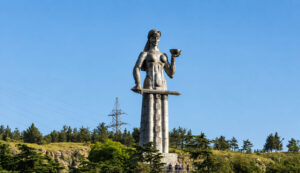
The grand monument "Mother of Georgia" ("Kartlis Deda") is one of the most recognizable symbols of Tbilisi. This 20-meter aluminum monument was erected in 1958 for the 1500-year anniversary of Tbilisi, designed by prominent sculptor Elguja Amashukeli. The stately female figure in traditional Georgian dress rises above the city at nearly 480 meters above sea level and is visible from almost anywhere in the historic center.
The sculpture accurately and expressively embodies the national character of the Georgian people: in her left hand, the mother holds a bowl of wine for those who come to this land with peace and goodwill, and in her right hand, an unsheathed sword for those who appear as enemies. Comfortable viewing terraces are equipped along the pedestrian avenue at the foot of the monument, opening up an extraordinary panorama of the Mtkvari River, tiled roofs, and winding alleys of the old quarters: a view that back in the 19th century enchanted travelers from all over the world.
🕐 Approximate visiting time: 15–20 minutes.
From the "Mother of Georgia" monument begins a scenic descent down the historic stone Betlemi stairs straight into the bohemian quarter of Sololaki. Carved wooden balconies and steep alleys gradually give way to respectable Art Nouveau mansion facades. We descend to shady Machabeli Street, where behind the solid oak door of house number 17, a genuine oriental palace awaits us.

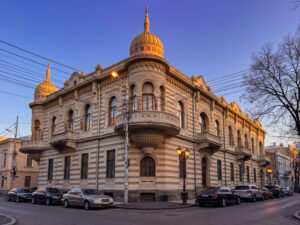
On quiet Machabeli Street at number 17 stands the famous House of merchant Mikhail Kalantarov. This two-story building, erected in 1908 to a design by architect Lazar Sarkisyan, is recognized as an unrivaled gem of Tiflis Art Nouveau and pseudo-Moorish style. In the early 20th century, oriental motifs were regarded among wealthy merchants as a hallmark of refined taste and status, but the facade impresses with more than just exoticism: it was intentionally designed asymmetrical, making the building feel fluid, alive, and filled with almost theatrical dynamism.
The mansion is steeped in one of the most touching romantic legends of old Tiflis. According to legend, the merchant fell in love with an opera singer performing on the Tiflis stage, and the young woman half-jokingly promised to marry him only if he built her a real palace resembling an oriental fairy tale. Kalantarov personally supervised construction: the three central windows of the second floor were adorned with deep Moorish arches and slender paired columns, while the delicate lace ornament of the facade was skillfully carved not from stone, but from ganch, a lightweight mixture of gypsum and clay. In the courtyard garden, a fountain began to bubble and six slender cypresses rose, the merchant having planted a tree in honor of each of his six children, and these centenary trees rustle their branches here to this day.
🕐 Approximate visiting time: 15–20 minutes.
Walking just a few dozen meters further along quiet Machabeli Street, we stop before a luxurious two-story mansion at number 13. Its aristocratic facade with elegant balconies and centuries-old plane trees preserves memories of the golden age of Georgian culture.

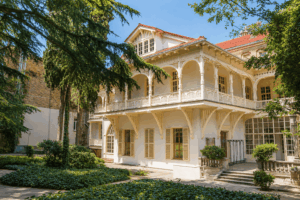
Just next door, at 13 Machabeli Street, is the Writers' House of Georgia, one of the most prestigious and historically significant mansions of old Tiflis. The two-story gray building combines the understated elegance of German Art Nouveau with Baroque forms. The mansion was built in 1903–1905 according to a design by Berlin architect Carl Zaar for the founder of Georgian cognac production and great philanthropist David Sarajishvili, who timed the housewarming to celebrate the silver wedding anniversary with his wife Ekaterine. For its era, the house represented technical progress: it featured its own boiler room, an advanced heating system, and electric lighting, an unprecedented luxury for the city at the turn of the last century.
The estate quickly became the premier salon of the Tiflis intellectual elite, and after 1921 the house was handed over to the Union of Writers of Georgia; its ceremonial oak halls remember readings by Vladimir Mayakovsky, Osip Mandelstam, Sergei Yesenin, and Boris Pasternak. In July 1937, the mansion witnessed tragedy: at the height of Stalin's purges, the prominent poet Paolo Iashvili, hounded by ideological interrogations, took his own life right inside the union building with a shotgun. Be sure to step out onto the open terrace overlooking the shaded courtyard garden: under your feet remains the original ceramic pattern of famous German Villeroy & Boch tile, ordered by Sarajishvili directly from Germany more than one hundred and twenty years ago.
🕐 Approximate visiting time: 25–35 minutes.
Leaving the shaded garden of the Writers' House, we delve into the alleys of Sololaki and head toward Betlemi Street. Among the weathered yet poetic old facades hides one of the most photogenic and romantic residential hallways in Tbilisi.

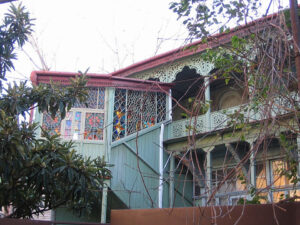
Walking slightly deeper into Sololaki to the intersection of Betlemi and Askani streets in the Kldisubani quarter, you will see a two-story house behind whose carved door hides one of the most recognizable and poetic interiors of Tbilisi, the stained-glass "Kaleidoscope" hallway. This brick building with lace-like balconies appeared at the foot of the Sololaki rock back in the 1840s. In the first half of the 19th century, colored glass was imported from Europe, cost a fortune, and served as the foremost symbol of the owners' wealth. At the same time, the stained-glass windows fulfilled an important practical purpose: they protected steep wooden flights of stairs from harsh mountain winds, downpours, and dust, prolonging the life of the century-old timber structures.
The main magic of the house reveals itself through the natural play of light. Slender carved mullions hold hundreds of panes of colored glass: ruby, sapphire, azure, and amber, turning the stairwell into a giant living kaleidoscope. It is best to visit here in the morning or just before sunset, when sunlight filters through the colored panes at a sharp angle, flooding the wooden steps and walls with dazzling colored reflections. Although the interior is currently closed to preserve its historic structures, admiring the iridescent light through the open door and second-floor windows is definitely worthwhile for every guest in the capital.
🕐 Approximate visiting time: 15–20 minutes.
Having admired the multicolored stained-glass reflections, we conclude our walking tour through Sololaki and head toward the lower funicular station on Chonkadze Street. You can walk up to it at an easy pace in 15 minutes along the picturesque streets of Mtatsminda or take a 2-minute ride in a Bolt taxi. Ahead lies the culminating and most impressive finale of our day!


The ideal finale of a full day in Tbilisi is an ascent to the sacred summit of Mount Mtatsminda ("Holy Mountain"), towering over the capital by more than 700 meters. From the Sololaki district to the lower station of the Tbilisi Funicular on Chonkadze Street, you can take a 5–7 minute taxi ride or enjoy a walk on foot. This historic funicular was built back in 1905. Today, modern panoramic carriages with a transparent roof glide smoothly up the steep rocky slope over 500 meters long, opening up captivating views across the rooftops of the old town. For fare payment, a separate plastic Mtatsminda Park card is purchased (costs 2 GEL, the ride itself is 10 GEL; the MetroMoney card is not valid here).
📌 Useful recommendation: if you still have energy left, be sure to step off at the intermediate "Pantheon" stop. Here you will find one of the most revered churches in Tbilisi, the Church of Saint David ("Mamadaviti"), founded on the site of the cell of Saint David of Gareja in the 6th century, a holy cave with a healing spring, as well as the famous Pantheon on Mtatsminda (Pantheon of Writers and Public Figures of Georgia), where playwright Alexander Griboyedov rests with his young wife Nino Chavchavadze.
If you are tired after the long walk or in a hurry to catch the sunset, ascend straight to the uppermost station at Mtatsminda Park. Shaded avenues, a giant Ferris wheel, and spacious viewing terraces spread out on the plateau, where the entire city is seen as if in the palm of your hand: in sunset rays the mountains turn golden hues, and with the onset of dusk Tbilisi lights up with millions of lights.
The culmination of the evening will be a visit to the restaurant complex "Funicular": right inside the complex itself, in its famous first-floor cafeteria, they bake the legendary Tbilisi donuts with delicate custard or chocolate and serve the cult lemonade "Lagidze Waters" straight from conical flasks with tarragon, cream, or pear flavors. This crispy dessert with a refreshing drink and panoramic view of the glittering night city will be the sweetest and most memorable chord of your trip!
🕐 Approximate visiting time: 1.5–2 hours (including ascent, walk, and rest in the cafe).
So that your one-day acquaintance with the capital of Georgia is smooth, comfortable, and leaves only the warmest memories, we have compiled several practical tips:
Do not try to outrun time: the main charm of Tbilisi reveals itself not in rushing through a checklist, but in pauses. If you feel tired, sit down on the terrace of a coffee shop in Sololaki, order a cup of oriental coffee or a glass of Rkatsiteli, and simply watch the unhurried life of the old quarters.
Choose shoes with non-slip soles: historical Tbilisi is paved with authentic cobblestones polished by millions of steps to mirror smoothness, while climbs to Narikala and descents along the Betlemi stairs are quite steep. Comfortable, well-worn sneakers or soft trekking shoes are the key to the health of your feet.
Use drinking fountains (pulpulaki): do not carry heavy water bottles with you. Across the whole city, in public squares, near churches, and on pedestrian streets, free fountains with pure, cold mountain drinking water are installed. It is completely safe and quenches thirst wonderfully on a warm day.
Remember the dress code in active churches: when visiting Anchiskhati Basilica, Metekhi Church, or Saint David Church on Mtatsminda, shoulders and knees must be covered. Women will need to cover their head with a scarf (free scarves and wrap skirts are always available at the entrance to every church).
Turn into open hallways and Italian courtyards: the most sincere magic of Tbilisi hides deep within the quarters. If you see a carved oak door slightly open in Sololaki or a vine-covered arch into a courtyard with laundry lines, look inside politely: masterpieces of antique stucco, wrought-iron spiral staircases, and unique Tbilisi coziness live there.
Evening return: after sunset on Mtatsminda, descend on the funicular to the lower station. From Chonkadze Street, it is most convenient to hail a taxi: the ride to Freedom Square or your hotel will take a few minutes and save your strength after a full walking day.
One day in Tbilisi flies by like a single moment, but leaves memories for a lifetime. You managed to touch a fifteen-hundred-year-old sanctuary at Anchiskhati Basilica, hear the fairytale clock chime of Rezo Gabriadze, breathe in the sulfur warmth of Abanotubani, fly in a transparent cable car cabin over the Mtkvari, and greet the sunset from the dizzying height of Mtatsminda to the crunch of a hot Tbilisi donut. This city is impossible to fathom completely in twenty-four hours, but impossible not to fall in love with at first sight. And standing on the upper terrace of the funicular, looking at the boundless glowing sea of Tbilisi lights, you will surely catch yourself thinking: this is only the beginning of a great friendship with Georgia, and you will definitely return here again.