EN

Georgia is a country that makes you fall in love at first sight with its hospitality, magnificent landscapes, and, of course, delicious food. But is it worth going there with children? The answer is an unequivocal yes! Moreover, this trip is much simpler to organize than it seems: no visa is required for Russians, and even the smallest passengers will easily handle the short flight.
Infrastructure for tourists is developed: in Tbilisi, Batumi, and other popular places there are family hotels, restaurants with children's menus, and play areas.
Georgia's climate is suitable for children: mild summers on the Black Sea coast and cool mountain areas are ideal for walks. Food is natural and varied: from fresh fruit to homemade cheeses, which is important for children's nutrition.
Georgia is an ideal place for family vacations, where children will be delighted with adventures and parents can relax while enjoying culture and nature.
In this article, we will explain how to plan a memorable trip with children: from choosing the season and resort to children's menus and required documents.
Table of contents

Cafe Fantasia / Photo: Masha Kondrasheva / Wikimedia
Flight time from Moscow: to Batumi or Tbilisi is about 3.5 hours.
Time: difference with Moscow is +1 hour.
When the beach season starts: on the Black Sea coast, the resort season lasts from late May to late September, while the best time for excursions is May, June, and September.
Average seasonal temperature: summer +27 °C, autumn +18 °C, winter +9 °C, spring +15 °C.
Currency: Georgian lari, 1 GEL.
Language: Georgian, but there will be no communication problems. The older generation speaks Russian well, and youth in tourist centers speak English.
June and September (velvet season): ideal time for a trip to the sea. The water is already warm (+22…+25°C), the sun is not as harsh, and most importantly, there are significantly fewer tourists than during peak season. Housing prices can also be lower.
July and August: peak season. It is very hot and humid on the coast (+25…+30°C and higher), and beaches and popular spots are crowded. This is a time for those who enjoy a lively atmosphere. In the mountains (Borjomi, Bakuriani), there is comfortable coolness at this time.
May and October: great time for excursions around Tbilisi and trips around Kakheti. The weather is warm and pleasant, without exhausting heat. For swimming in the sea it is still or already cool.
Winter (December–February): time for ski resorts such as Bakuriani and Gudauri.
You can reach Georgia with children in several ways. The choice depends on your budget, departure city, and readiness for adventure. The fastest and most comfortable way is a direct flight, but more budget-friendly routes also exist.
Airplane: this is the most comfortable and convenient option for traveling with children. Direct flights from Moscow, Saint Petersburg, and other major Russian cities to Georgia take on average 3–4.5 hours. Main arrival airports are Tbilisi (TBS), Batumi (BUS), and Kutaisi (KUT). Ticket costs strongly depend on the season and airline, but on average one can expect 12,000–25,000 rubles for a one-way ticket per person. You can track flight prices through aggregator websites, for example Aviasales.
Flight + bus/taxi: this method involves flying to Vladikavkaz and subsequent overland transfer across the border (Upper Lars checkpoint) to Tbilisi. In terms of cost, this is often cheaper than a direct flight: the average ticket price to Vladikavkaz is about 12,000 rubles, and a seat in a minibus to Tbilisi is another 3,500 rubles per person. An individual taxi transfer for the whole family will cost about 10,000 rubles, but will be significantly more comfortable. The main downside of this route is its duration and unpredictable border queues, which can make the entire journey a serious ordeal for children.
By car: traveling in your own car also passes through the only overland border crossing, Upper Lars. This option gives complete freedom of movement in Georgia, but requires serious preparation. The road is very long, and border crossing times are unpredictable. This method suits experienced road trippers living in southern regions of Russia, and can become a real challenge for families with young children. You can track up-to-date information on the border situation in the Upper Lars Telegram chat.
Georgia is one of the most hospitable and accessible countries; however, preparing documents for a trip with a child should be handled carefully to avoid any misunderstandings at the border. Although a visa is not needed, there are several important nuances regarding passports and consent to travel.

Documents for entering Georgia with children / Bizzz Media
Visa: according to 2025 data, citizens of Russia, Ukraine, Belarus, Kazakhstan, and more than 92 other countries do not require a visa to enter Georgia. The permitted period of visa-free stay for them is up to one year.
Children's international passport: it is recommended to obtain a separate international passport for a child of any age. This is the only 100% reliable option. Theoretically, children under 14 can be entered into a parent's old-style passport, but this is an outdated and unreliable practice: a separate document may be required at the border. To avoid problems, it is better not to risk it.
When obtaining an international passport for a child, you have two options that differ in validity period, cost, and some practical nuances.
Birth certificate: be sure to take the original or a notarized copy with you. This document confirms kinship, which is especially important if you and the child have different surnames or you are traveling with an incomplete family. Georgian border guards request it rarely, but it may be needed when departing from your country or in other situations.
Notarized consent to travel: this is a point that is important to understand clearly. If a child travels with one parent, by law consent from the second parent is not required (unless an official travel ban exists). If the child travels without parents (with a grandmother, grandfather, or coach), then notarized consent to travel from one parent is strictly mandatory.
Medical insurance: this document is mandatory for entry from 2026, and is critically important for your peace of mind and wallet, as medical care for tourists is fee-based. Obtain a policy covering hospitalization and outpatient treatment.
Georgia is a country where you can vacation in comfort on any budget. To make it easier for you to plan expenses, first decide on your travel style.
Budget vacation involves staying in guesthouses, getting around by minibus, and mostly self-catering with occasional visits to inexpensive cafes. Such a format will cost approximately 200–250 GEL per family per day.
Comfortable vacation is the most realistic and popular scenario for most families. It includes apartment rental, car rental for part of the trip, balanced meals (cafes + cooking), and visiting all main attractions. Aim for a budget of 350–450 GEL per family per day.
Vacation without limits means staying in good hotels, eating exclusively in restaurants, constantly using taxis or cars with drivers, and private excursions. Such a vacation will cost from 600 GEL per family per day and above.

Examples of entertainment costs (as of June 2025):
So how much money should you take for 10–15 days?
Aiming for a comfortable style of rest, your family of three will need (not including airfare):
Do not forget a reserve for souvenirs and unforeseen expenses. In addition to main expenses for lodging, food, and transport, it is always worth budgeting an extra amount. It is impossible to leave Georgia without wine, cheese, or spices, and a "just in case" reserve will cover a spontaneous excursion or unplanned taxi ride. As practice shows, a comfortable financial cushion is about 15–20% of your main budget.
How to pay in Georgia?
Russian Mir, Visa, and Mastercard cards do not work in Georgia. Therefore, the main payment method for tourists from Russia is cash. The most convenient option is to bring dollars or euros with you and exchange them for GEL on site. Exchange offices are on every corner in cities, and rates there are usually better than at the airport.
UnionPay cards issued by Russian banks are accepted in Georgia with limitations and unstably. Take one as a backup option in case of emergency for withdrawing cash at an ATM, but carry your main budget in cash currency (dollars or euros). Keep in mind that cash amounts up to the equivalent of 25,000 GEL (about $10,000) can be brought into Georgia without declaration.

Main resorts of Georgia / Bizzz Media
Choosing a destination is essentially choosing between three types of vacation: beach, mountain, and urban. The right decision depends on the age of your children and expectations from your vacation.
If your goal is the sea, the main question is sand or pebbles? For entertainment on pebble beaches, people go to modern Batumi. Its calmer neighbor, Kobuleti, offers similar pebbles, but framed by a pine forest. If black sand and safety for young children are your priority, your choice is Ureki or Shekvetili.
For mountain wellness, Borjomi is the ideal place: a famous resort with mineral springs and the purest pine-scented air. And for a short city adventure, the capital Tbilisi is best, which is convenient to include in your itinerary for 2–4 days.
The best time for a beach vacation in Batumi is considered June and the "velvet season" (late August – September). In these months, sea water temperature stays at a comfortable +23...+25°C, and air temperature at +24...+28°C. This allows you to avoid peak heat and large crowds typical of July and August.
For detailed planning and weather information for other months, the guide to climate and seasons in Batumi will be useful.

Aerial view of Batumi / Photo: mikelaptev / Freepik
Entertainment: Batumi Dolphinarium, May 6th Park with its mini-zoo, the famous 7-kilometer boulevard with bike lanes and playgrounds, Argo cable car and the Botanical Garden.
Pebble beaches: this can be uncomfortable for little ones, so water shoes are an absolute essential. The cleanest and less crowded beaches should be sought in the New Boulevard area or picturesque suburbs.
Pros: maximum entertainment, developed infrastructure, easy to reach.
Cons: pebble beach, crowded and noisy in July–August, limited hotel animation. However, even within city limits, one can find comfortable swimming spots.
Ureki is ideally suited for a safe vacation with young children (ages 0–6). People come here for unique curative magnetic sand and the shallowest sea on the coast. It is important to understand that this is a simple, village-style vacation, not hotel luxury.

Ureki / Photo: Bizzz Media
Entertainment: In Ureki itself, leisure for children is simple and straightforward: inflatable slides and trampolines right on the beach, as well as several carousels in the center of the settlement. The main plus is proximity to Shekvetili (10–15 minutes by car), where the huge Tsitsinatela amusement park and splendid Dendrological Park are located.
Beaches: Ureki's main asset is a wide, multi-kilometer strip with black magnetic sand. Entry into the sea here is incredibly gentle: to reach waist-deep water, an adult must walk 50–70 meters. This is the safest shallow paddling pool on the entire coast, where water warms up wonderfully.
Pros: ideal safety for toddlers, proven therapeutic effect of sand, budget-friendly accommodation and dining, cheerful and relaxed atmosphere.
Cons: very simple infrastructure, almost complete lack of entertainment for children older than 7–8 years, crowded and noisy in the central part during peak season, and plenty of mosquitoes in the evenings. However, choosing lodging slightly away from the center avoids many drawbacks.
Shekvetili is a choice for families who value comfort, quiet, and closeness to nature without sacrificing quality entertainment. This resort is considered a calmer and more manicured alternative to neighboring Ureki.

Paragraph Resort & Spa, Shekvetili / Photo: Bizzz Media
Entertainment: Shekvetili's main strength is three unique parks located nearby. The Dendrological Park with exotic animals and a bamboo grove, the Musicians' Park with singing sculptures, and the huge Tsitsinatela amusement park, which opens in the evening and shines with thousands of lights.
Beaches: here wide beaches with famous black magnetic sand await you, just like in Ureki, but often cleaner and less crowded. Gentle entry into the sea is ideal for children, but do not forget water shoes: dark sand heats up intensely in the sun.
Pros: the coast's best amusement parks within walking distance, clean beaches, calm atmosphere, and presence of high-class hotels.
Cons: higher vacation costs, limited choice of cafes outside hotels, and the practical necessity of having a car or using taxis for comfortable movement, as the resort stretches long along the coast. However, if your goal is precisely comfort and access to the best entertainment, Shekvetili will be an ideal choice.
Kobuleti, located just 20 km from Batumi, is justly called the "golden mean". Its main treasure is a unique microclimate created by a multi-kilometer strip of pine forest stretching right along the coast. The air here, saturated with pine scents and sea iodine, is considered curative and especially recommended for children with respiratory diseases.

Beach in Kobuleti / Photo: Bizzz Media
Entertainment: leisure in Kobuleti is unhurried: primarily walking and cycling along a very long promenade. However, the resort is conveniently located: from here it is easy to reach the Tsitsinatela amusement park (10–15 minutes by car), and all Batumi entertainment is just 20–30 minutes away.
Beaches: the coastline here is very long and wide, covered with small smooth pebbles that are much more comfortable to walk on than Batumi's large stones. Thanks to its extent, one can always find a relatively uncrowded spot even in peak season. Water entry is fairly gradual, but water shoes for toddlers will still not be redundant.
Pros: curative pine air, comfortable beach, calm atmosphere with all necessary infrastructure (cafes, shops, pharmacies), and more affordable prices than in Batumi.
Cons: still pebbles rather than sand; absence of large entertainment centers in the town itself; a simpler atmosphere without capital splendor. However, choosing the right area to stay can resolve many issues.
Borjomi is Georgia's main health resort, ideally suited for families seeking a quiet vacation, union with nature, and health benefits. People come here not for the sea, but for healing mountain air and famous mineral water.

Central Park in Borjomi / Photo: Bizzz Media
Entertainment: the foundation of leisure in Borjomi is the huge and shaded Central Park, ideal for long walks with a stroller. All main activities are concentrated here: you can taste warm mineral water directly from a spring (important: not all children like its specific salty taste), ride simple attractions, and take the cable car up to the Ferris wheel. From here, for older children, the main adventure begins: a trip on the Kukushka narrow-gauge railway to Bakuriani (2.5 hours one way). The town is also convenient as a base for day trips to Rabati Fortress and the cave town of Vardzia.
Pros: powerful healing effect (air and water), comfortable coolness in summer, calm and safe atmosphere, beautiful nature.
Cons: absence of the sea, limited choice of entertainment for teenagers, changeable weather and always cool evenings (warm clothes are mandatory), simpler infrastructure than in the capital.
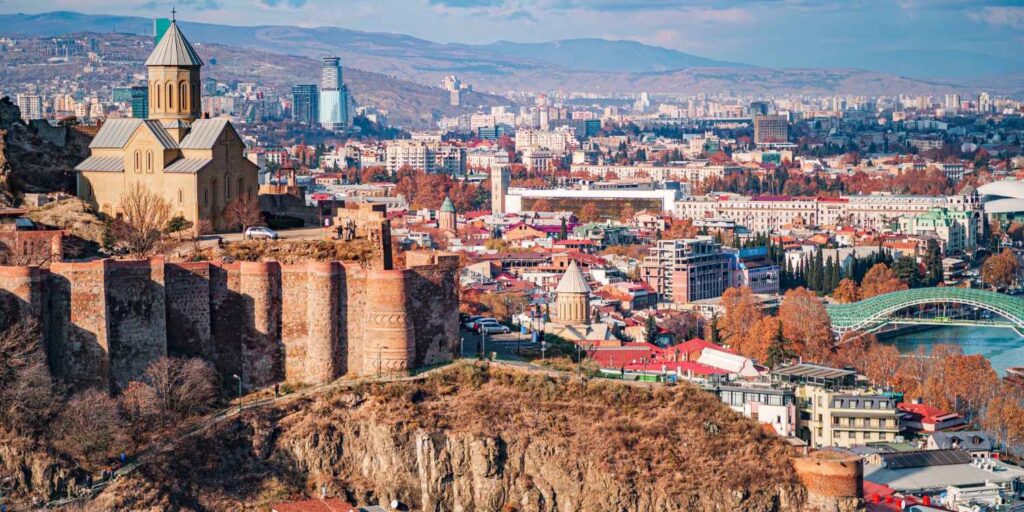
Tbilisi is the historical and cultural heart of Georgia, ideally suited for a rich stop of 2–4 days as part of a larger trip around the country. This is a city of contrasts where modern parks sit alongside ancient fortresses, offering plenty of impressions for children of any age.

View of the Tbilisi cable car / Photo: Bizzz Media
Entertainment: the main magnet for children is the amusement park Mtatsminda on the mountain, reached by a funicular. Riding the cable car to Narikala Fortress will cause no less delight. It is also worth visiting the Tbilisi Zoo, the interactive Experimentorium museum, Gino Paradise aqua park, and seeing the famous angel on the tower of the Marionette Theater of Rezo Gabriadze.
Old Town and atmosphere: the historic center of Tbilisi is a labyrinth of narrow streets, colorful courtyards, and ancient churches. Important: walking here with a stroller can be difficult due to cobblestones and steep climbs. In hot summer months, such walks are best planned for morning or evening, resting during the day in numerous parks and squares.
Pros: huge number of sights and entertainment, large selection of cafes and restaurants, unique atmosphere of the old city.
Cons: not suitable for a long lazy vacation, difficult terrain for walking with toddlers, summer heat, and heavy traffic in the center. However, smart planning helps avoid fatigue and see everything most interesting.
Choosing lodging is a key moment in planning a family trip. What suits you better: spacious apartments with their own kitchen, a full-service hotel, or a warm guesthouse? The answer depends on many factors: your children's age, vacation plans (sea or mountains), and whether you prefer to cook yourself or dine in restaurants. To help you make the right decision, below we examine in detail all pros and cons of each option.
📌 Where to look for housing in Georgia: from Russia it is convenient to book and pay for lodging on platforms such as Yandex Travel, Otello or Ostrovok.

Orbi residential complex / Photo: Bizzz Media
The main advantages of apartments are space and complete autonomy. A private kitchen resolves meal issues for toddlers, while having a washing machine and a separate room for the child creates familiar home comfort. On average, a good family apartment in Batumi will cost 90–220 GEL per night.
When choosing an apartment, especially in high-rises, pay attention to details. Carefully read recent reviews on sites like Booking.com. Reviewers often write about drawbacks such as poor soundproofing or long elevator queues in peak season. It is also worth clarifying with the host about the elevator. In some buildings it may be paid and operate via a special key. Usually this costs around 20 GEL per month.

Courtyard by Marriott Batumi Hotel / Photo: Sergio Guardiola Herrador
Hotels are a classic choice for those who want to disconnect completely from domestic chores on vacation and are willing to pay on average 150–350 GEL per night for it. Predictable service, daily housekeeping, and prepared breakfasts save a lot of energy, and reception staff are always ready to help. A big bonus, especially in Batumi, is an on-site swimming pool. The main drawbacks are typically less space and lack of a kitchen. When booking, do not forget to confirm baby cot availability.

Guesthouse Batumi Wonderland with a 9.4 rating on Booking / Photo: Bizzz Media
Guesthouses are the best way to experience famous Georgian hospitality and the most budget-friendly accommodation option, where a family room costs on average 80–120 GEL. The homely atmosphere and treats from hosts make you feel as though you are visiting distant relatives. It is important to understand that this is a compromise choice in terms of comfort: shared bathrooms and simple furnishings are common, and privacy will be lower here.
Getting around Georgia with children is not difficult at all, as the transport system here is well developed and offers options for any budget and comfort level. For maximum freedom, car rental is the ideal solution, especially if you have a driver's license. For long-distance trips between major cities, modern trains and comfortable buses run.
Car rental: the most convenient method for a family. It allows you to stay mobile and independent of schedules. Be sure to book a child car seat in advance.
Approximate rental cost starts from 100–120 GEL per day for an economy-class car.
You can book a car on the website Localrent.com (a popular aggregator with a good reputation).
Trains: comfortable double-decker Stadler trains run between major cities (Tbilisi–Batumi, Tbilisi–Kutaisi). This is a fast, safe, and very comfortable alternative to a car. Tickets can be purchased online on the official website of Georgian Railway. The approximate cost of a second-class ticket on the Tbilisi–Batumi train is 35 GEL.

Tbilisi–Batumi high-speed train / Photo: Bizzz Media
Intercity buses: a more comfortable option than minibuses, especially for popular routes. Metro Georgia and Georgian Bus have modern buses with air conditioning and Wi-Fi. Tickets can be bought in advance online. The approximate ticket price on the Tbilisi–Batumi service is about 40 GEL.
Minibuses: the most widespread and budget-friendly mode of transport for intercity travel, especially over short and medium distances. They depart from bus stations as they fill up. Note that this is not the most comfortable option for travel with small children. The approximate cost of a trip from Tbilisi to Batumi is 30–35 GEL, and to Borjomi about 15 GEL.
City buses: in major cities such as Tbilisi and Batumi, the public transport system is well developed. City buses are a modern and predictable option. It is important to know that fares are paid with a special transit card ("Metromoney" in Tbilisi, "Batumi Card" in Batumi) rather than cash. The trip cost is about 0.30–1 GEL.

City bus, Tbilisi / Photo: Kaga tau / Wikimedia
City minibuses: in turn, are more flexible, stop on demand, and accept cash payments to the driver. Fare in them averages 0.70–1 GEL.
Taxis: in cities it is convenient and cheap to use the Bolt or Yandex Go apps. It is important to remember that child seats are almost never present in cars.
Approximate trip cost around town is 5–10 GEL. An intercity trip (for example, Tbilisi–Borjomi) will cost 120–150 GEL.
One of the main questions for parents, but in Georgia it is resolved surprisingly easily. First, Georgian cuisine itself is rich in completely non-spicy dishes that children love: from all kinds of khachapuri and khinkali with cheese to tender skewers and homemade soups. Second, in any tourist city you will easily find restaurants with familiar European cuisine (pizza, pasta, mashed potatoes), and many establishments offer a convenient and straightforward children's menu.


Khachapuri: a win-win choice. Children especially love Adjarian style (boat-shaped with an egg) and Imeretian style (closed round cheese pie).
Mtsvadi (shashlik): order chicken or veal: this is lean meat prepared without spicy seasonings.
Potatoes: in practically any venue you can order mashed potatoes or home-style fried potatoes.
Chikhirtma: a classic light chicken soup, often with added egg for richness. It is recommended to ask not to add vinegar to it.
Khinkali: choose fillings of cheese, potatoes, or mushrooms. When ordering meat ones, specify clearly that they are for a child and ask to prepare them mild.
Mchadi: unleavened cornbread cakes that serve excellently instead of bread.
Matsoni: famous Georgian cultured milk product resembling thick plain yogurt.
Fresh salads: a basic salad of cucumbers and tomatoes can be requested dressed with oil only, without hot seasonings.
Desserts: churchkhela (nuts in grape juice) and pelamushi (grape juice pudding): healthy sweets safe for children.
Several useful cafe tips: do not hesitate to ask. Feel free to say "this is for a child, please make it non-spicy", verify portion sizes (they are often huge), and even ask to cook something simple not on the menu, like boiled potatoes or pasta. In Georgia there is such an attentive attitude toward children that staff will almost always respond to any request with a smile and understanding.
There are certain difficulties with familiar baby food in Georgia, so this issue should be thought through in advance.
In major supermarkets of Tbilisi and Batumi (Carrefour, Goodwill) and pharmacy chains (PSP, Aversi), you will find a basic set of fruit and vegetable purees, mostly locally produced. But the choice of meat purees and ready-made porridges is very meager. Familiar international brands (Hipp, Gerber, Semper) are rare and expensive. Finding your needed baby formula of a specific brand and number can also be a big problem. Outside big cities, in resort settlements like Ureki or Borjomi, the range will be even smaller or entirely absent.
Our main tip: Be sure to bring a full supply of your child's familiar formula and at least half the supply of jarred food for the entire trip. As an alternative on site, you can buy natural matsoni (instead of baby cottage cheese and yogurt) and prepare purees yourself from fresh market vegetables if staying in an apartment.

Parekhi Market, Batumi / Photo: Bizzz Media
In addition to supermarkets, be sure to visit a local market: this is not only a treasury of fresh products, but also a true immersion in Georgian character. It is here that you should buy seasonal fruits (fragrant peaches, figs, grapes) and vegetables whose taste you will remember for a long time. For children, feel free to take homemade cheeses: delicate, mild sulguni and creamy curd-like nadugi, and for dessert: famous churchkhela and natural dried fruit puree (tklapi). A special pleasure is buying hot, crispy shoti bread right from the tone oven.
Important tip: All vegetables and fruits bought at the market must be washed thoroughly before eating, preferably with bottled water. At markets, it is customary to bargain a little, and almost everywhere payment is accepted only in cash.
Georgia is a very safe and hospitable country; however, when traveling with children, it is always worth paying special attention to health issues and being prepared for any situation. Below we look at what to pay special attention to.
First aid kit: although pharmacies in Georgia are found at every turn, it is better to assemble a familiar set of medications from home. Be sure to bring fever reducers and pain relievers based on paracetamol or ibuprofen in child dosages, as well as products for gastrointestinal issues: sorbents (such as Enterosgel), diarrhea medication, and probiotics. Do not forget antihistamines in drops or tablets and a gel for insect bites. For treating scrapes, antiseptic, adhesive bandages, and a bandage will come in handy. In addition, the first aid kit should include an electronic thermometer, motion sickness medication, sunscreen, and child insect repellent.
Georgia is one of the safest countries in the region with a very low street crime rate. Here you can calmly walk in the evenings without fear for yourself and your children. Nonetheless, we advise observing basic precautions: do not leave valuables unattended on the beach or in cafes, and stay alert in tourist locations.
Water: drink only bottled water. Use it to wash all fruits, vegetables, and children's dishes, and also for brushing teeth.
Sun: the Georgian sun is very active. Be sure to use SPF 50+ sunscreen, wear headwear, and try to stay in the shade during peak hours (from 12:00 to 16:00).
Food safety: wash hands thoroughly before meals. Choose cafes and restaurants with a good flow of visitors. Be cautious with street food, especially dairy and meat items, in hot weather.
Stray dogs: on the streets of Georgian cities, especially in Batumi, you will meet many dogs with a tag on their ear. There is no need to fear them: almost all are microchipped, vaccinated, and completely friendly toward humans. However, explain to the child that, like any unfamiliar animals, they should not be teased or touched obtrusively.
Insects: on summer evenings, especially near water bodies, mosquitoes may appear. Use repellents and fumigators in your room.
Road safety: city traffic can be chaotic. Be extremely attentive when crossing streets and always hold the child by the hand.
Main number: the single emergency services number (fire, police, ambulance) is 112.
If a child gets sick: first of all, call the telephone number indicated on your insurance policy. The assistance company operator will coordinate you and direct you to the appropriate clinic with which they have a contract.
Clinics: in major cities such as Tbilisi and Batumi, there are modern private medical centers (for example, Evex, MediClub) where insurance is accepted and English- and Russian-speaking staff are available.

Old Town, Tbilisi / Photo: bykot30 / Freepik
Georgia is one of the most child-friendly destinations imaginable. It is a safe, delicious, and incredibly beautiful country, a journey through which will leave your family with the warmest memories. For the trip to go ideally, remember three main principles.
First, choose the location to match the age, not your own wishes. The main secret to a successful vacation is matching the location to the child's needs. A one-year-old toddler will be more comfortable on the sand in Ureki rather than noisy Batumi, while a teenager, conversely, might be bored in a quiet health-resort town.
Second, slow your pace and do not try to embrace the boundless. Georgia is a country for unhurried enjoyment: long lunches, walks without a set destination, and chance conversations. It is better to truly experience one region than rush through five, especially with children who tire quickly from transit.
And finally, be flexible and trust people. Plan only key moments in advance: housing, tickets, and documents. As for the rest, allow yourself a bit of improvisation. Georgians are very responsive and will always help, advise, and meet you halfway, especially if they see that you are traveling with children. Just relax and enjoy.